Hiya Health
Designing Trusted AI Communication for Healthcare's Frontline

Role & Team
Timeframe
Company
Responsibility
Impact
100%
Adoption intent from frontline staff testing ("I would love to use this system at my clinic")
20+
Stakeholders aligned across AI leadership and product teams
7 months
0→1 product delivery from ambiguous brief to tested MVP
Business Goal
Hiya's challenge: Design the future of trusted AI communication
Our team faced complete ambiguity. No specs. No defined users. Just 7 months to deliver impact.
Through strategic research and stakeholder workshops, we identified healthcare as the ideal testing ground: high-stakes communication, strict privacy requirements, and the need for trust make it perfect for proving AI's value.
User Problem
Frontline healthcare staff can't focus on patients because they're overwhelmed by phone systems

Staff are drowning in calls "We're answering phones, scheduling, checking in patients, triaging—all at once."
Patients experience fragmented care Endless phone trees, long holds, and information lost between handoffs lead to missed or delayed care.
Solution
An AI communication system that prevents missed, rushed, and fragmented patient care
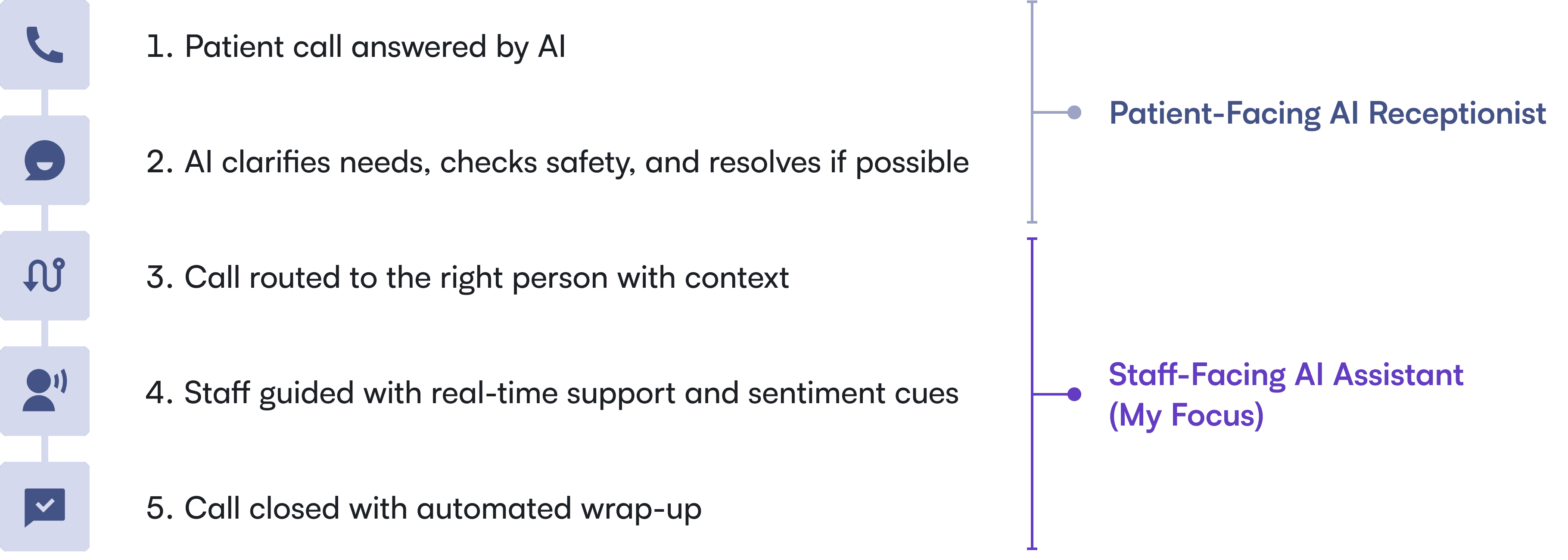
The system has two integrated parts working seamlessly:
1. AI Receptionist (Patient-facing): Answers calls immediately, gathers context, handles routine requests, routes complex needs to the right person
2. AI Assistant (Staff-facing): Provides instant call context, real-time guidance during conversations, automated follow-up
Vision
From scattered workflows to seamless handoffs
Before: Patients navigate phone trees → Wait on hold → Repeat information → Get transferred → Start over
After: AI answers immediately → Gathers context → Routes to right person with full context → Staff focuses on care
Jump to Design Highlights
So, how did I get here? It all started with...
Problem Scoping
Why Service-Based SMB? Why Healthcare?
We chose service-based small businesses because:
1. Massive Market Opportunity: 85.7% of SMBs are service-based (Proweaver, 2024)
2. AI Automation Demand: Service SMBs using AI see 5X faster response times and 20-30% higher conversions (Carta & McKinsey, 2024).
3. Hiya’s Strategic Strengths: Already trusted by 500M+ users for caller ID and voice intelligence
Healthcare is the perfect proving ground for AI communication because:
Trust is non-negotiable - Mistakes affect patient health and business revenue
Scalable constraints - HIPAA compliance translates to other regulated industries
Clear AI value - High call volume and emotional complexity create obvious opportunities
What do users actually need?
AI’s Value Lies in Supporting Human-Centered Care
I conducted 10 interviews with frontline staff and patients to understand AI's role in healthcare communication.
It was found that both patients and staff are resistant to AI handling emotionally sensitive communication, emphasizing that empathy, trust, and human judgment are essential. I also identified opportunities for AI in supporting professional communication, making scheduling easier and smarter, and simplifying care tasks across fragmented systems.

How might we re-envision healthcare communication using AI to increase frontline staff efficiency without losing human touch?
Design Direction
3 principles for designing trusted AI in healthcare
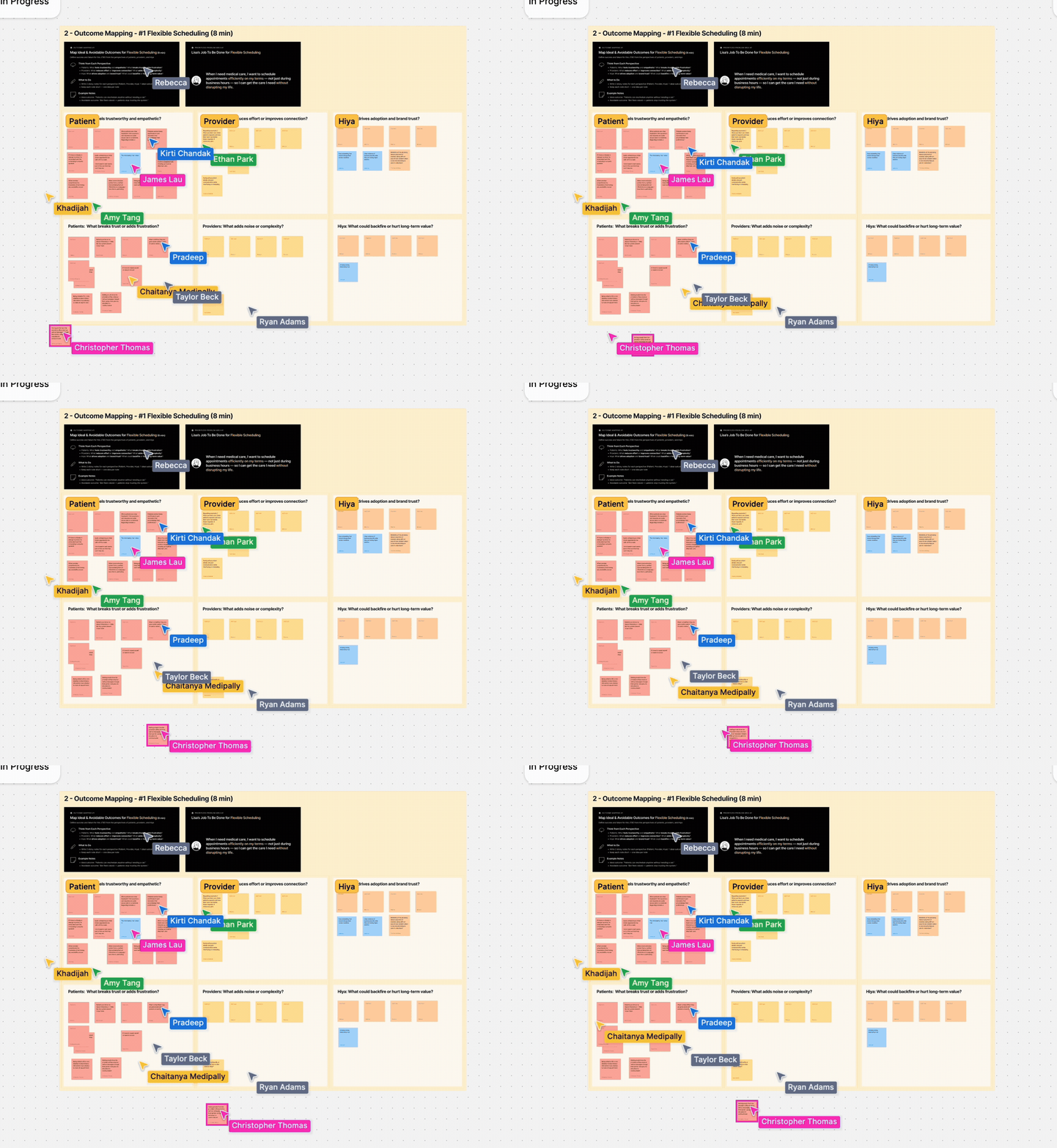
Working with 20+ stakeholders across Hiya's AI leadership and product teams, we aligned on design principles:
Keep Humans Connected: Preserve human relationships and enable seamless handoffs
Clear AI Involvement: Be transparent about AI involvement and demonstrate value
Enhance, Never Replace: Apply AI where it adds value (Efficiency), not where it replaces care (Empathy)
Hard requirement: Protect patient data and privacy (HIPAA compliance)
Design Highlights
Hiya Health: Quick Access and Human Connection at the Frontline
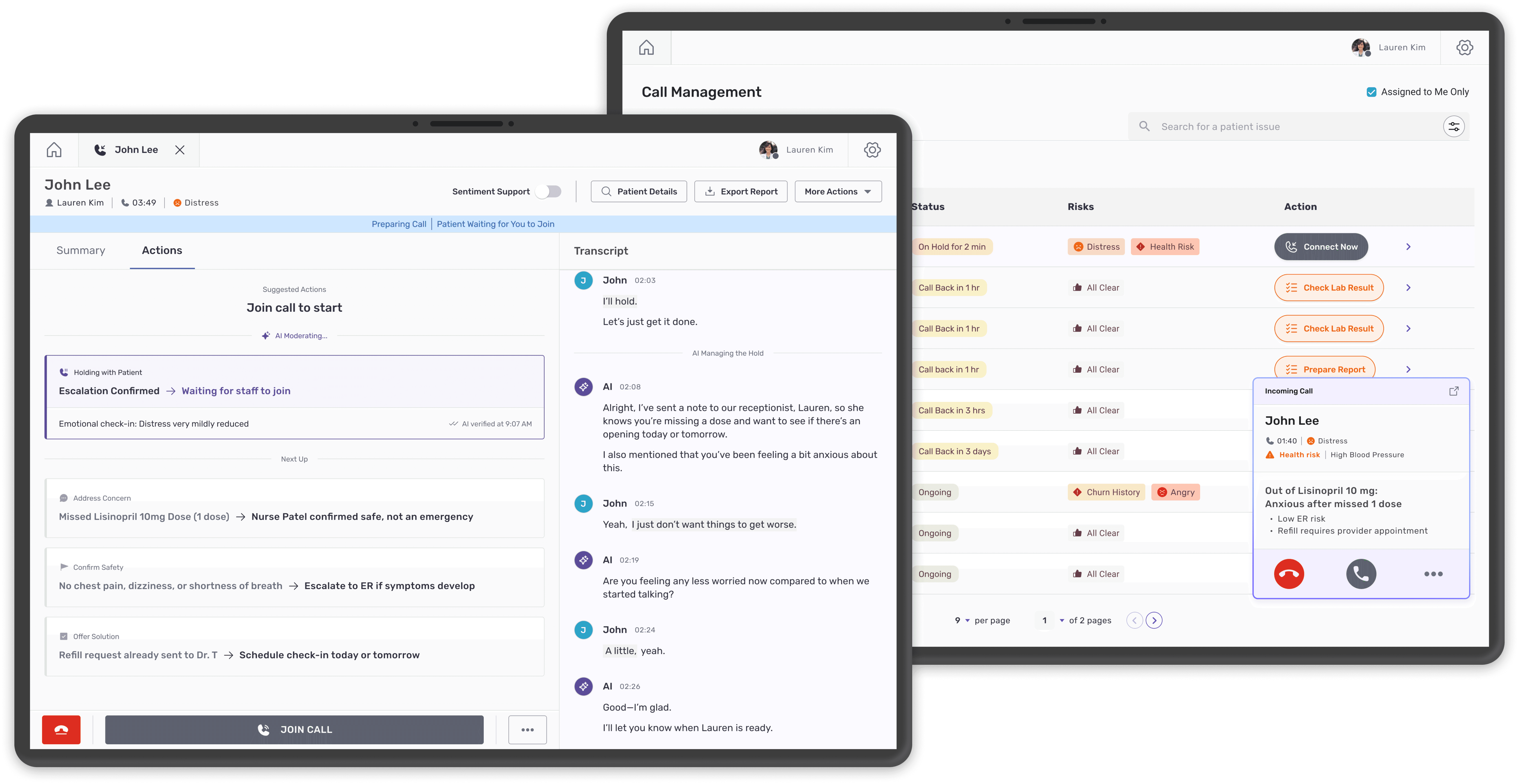
Before the call: Staff know exactly what's happening before they answer
Instead of picking up blind, frontline staff see instant context—who's calling, why they're calling, and relevant patient history.
During the call: AI supports without getting in the way
Staff focus on the patient while AI handles scheduling, documentation, and provides real-time suggestions only when needed.
After the call: Automated documentation saves time and ensures nothing is lost
Call summaries, action items, and follow-ups are generated automatically. Staff review and approve in seconds instead of spending minutes on manual entry.
User Feedback
100% of users said yes to adopting our product
I conducted cognitive walkthroughs with 12 healthcare staff members, testing the interface for managing calls and supporting live conversations. All users expressed immediate adoption intent. They trusted the AI-provided context, and believe this would improve their efficiency significantly.
“This is a system I'd willingly like to jump into. If this system was active, we would have more problems solved.”
- P1 · Medical Assistant
“Yeah I trust the system... The AI syncs up with information so everything can be seamless and fast."
- P3 · Clinic Owner
“Definitely it's speeding up my workflow.”
- P2 · Senior Receptionist
“Very useful... I would love to use this system at my clinic."
- P4 · Office Manager
Stakeholder Impact
Our design provided strategic foundation for Hiya's AI future
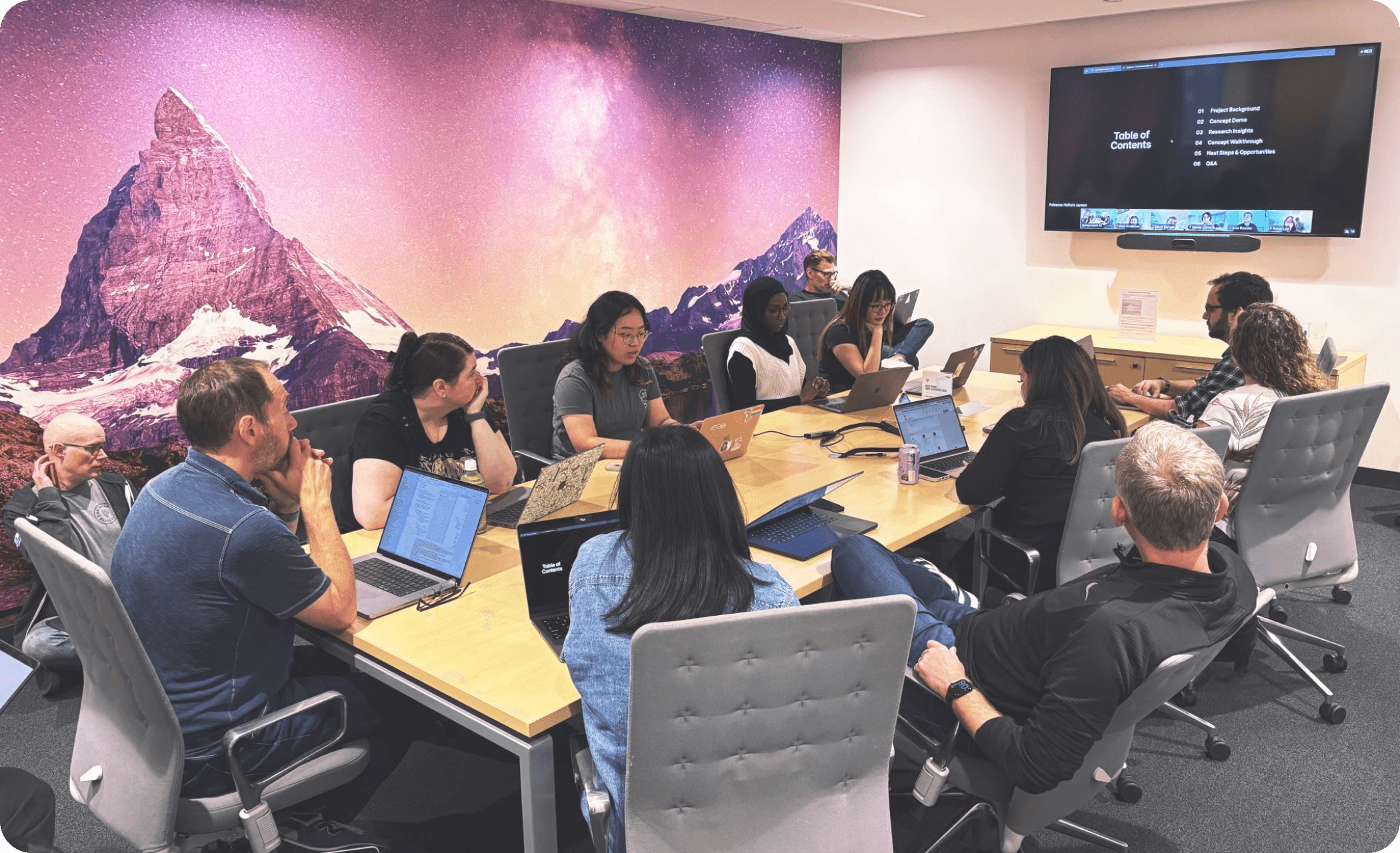
We presented our work to 20+ people at Hiya, including the leadership and AI team.
We got favorable feedback as our product is well-researched and designed, and ready for launch.
“The direction you landed is well-researched and provides a strategic foundation for future AI communication development. The level of detail and thought put into every aspect was exceptionally impressive.”
- Principle UX Researcher, Hiya
"We had so many takeaways from what they got in this that we can apply to the things that Hiya uses, in regards to AI interactions and our voice calls. This work exceeded my expectations in both depth and quality.
- Director of Product Design, Hiya
Retrospectives
Next Steps
Integration with Healthcare Systems (EHR/EMR) by creating a seamless task flow and further adhering to compliance & security
Role-Based Controls for Different Staff Levels (i.e., Allow senior staff to reassign or take over calls)
Explore potentials to transform the high-stakes industry by collaborating with clinics for implementation
Designing for High-Stakes Environment
When designing for high-stakes environments, every decision matters. We couldn't just make things 'nice to have.' We needed to prioritize clarity, empathy, and trust.
Ambiguity as an Opportinity
Ambiguity isn't a barrier - it's an opportunity. The time we spent on discovery research and conversations with the client helped me better understand the healthcare problem space and design for actual business goals and user needs.
Balancing Efficiency and Empathy while Designing for AI
AI isn't all about removing humans from the equation. It's more about amplifying human capabilities. Healthcare communication in 2030 won't be about choosing between efficiency and empathy. It'll be about achieving both. When we design AI thoughtfully, we don't replace human connection - we protect and enhance it.
If you would like to learn more, please contact Ariana for more information.
arianazhu.design@gmail.com
Copied